 DE
DE
 EN
EN




Health in All Policies
Why Health is a Political Choice
The health of a population is the result of complex interactions that extend far beyond individual behavior and medical care. In Germany, 74% of deaths are attributable to non-communicable diseases such as cardiovascular diseases, which are closely linked to living and environmental conditions. These conditions—the quality of the air we breathe, the safety of our workplaces, access to education and healthy food, or the design of our cities—are largely shaped by political decisions. Health is therefore, as the World Health Organization (WHO) states, a political choice ("Health is a political choice").
The strategic "Health in All Policies" (HiAP) approach reflects this understanding. It views health not as an isolated policy area, but as a cross-cutting issue that must be systematically considered in all political decisions. This report examines the concept of HiAP, analyzes its implementation in Germany, and highlights specific areas for improvement to effectively and sustainably promote the health of the entire population.
1. The Foundation of "Health in All Policies": Health as a Whole-of-Society Task
The "Health in All Policies" approach is the logical evolution of decades of public health insights. It provides a strategic framework to address the diverse determinants of health in a coordinated and targeted manner.
Definition according to the WHO
The WHO defined HiAP at the 8th Global Conference on Health Promotion as "an approach to public policy across all sectors that systematically takes into account the health implications of decisions, seeks synergies, and avoids harmful health impacts." The overarching goal is to improve and formalize the accountability of policymakers for the health consequences of their actions at all levels.
Historical Roots
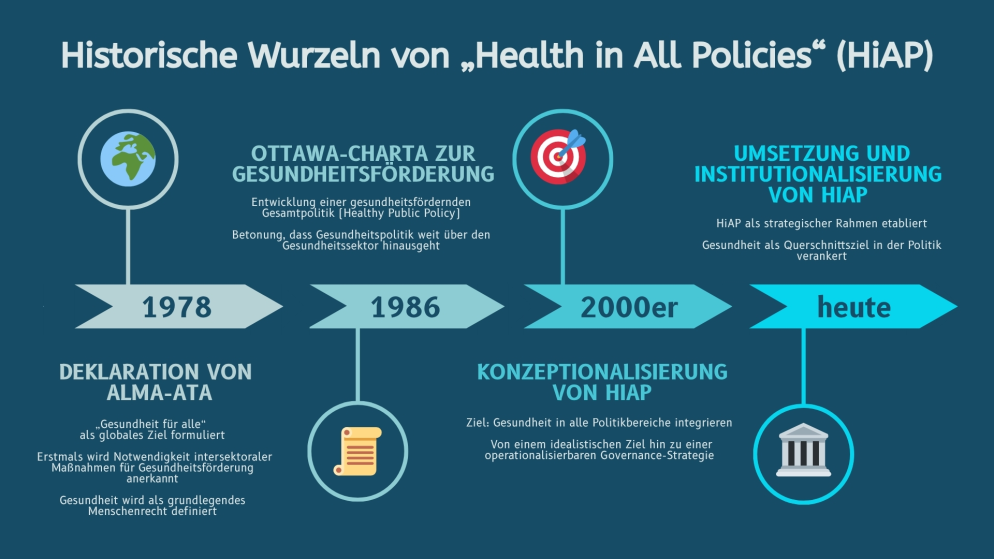
The idea of cross-sectoral collaboration is not new. Its roots reach back to the Declaration of Alma-Ata (1978), which for the first time formally recognized the need for intersectoral action for health promotion. A crucial milestone was the Ottawa Charter for Health Promotion (1986). It established the "development of healthy public policy" (Healthy Public Policy) as a central area of action and emphasized that health policy extends far beyond the health sector.
HiAP builds upon this foundation but takes a decisive step further. While "Healthy Public Policy" was often understood as a metaphorical appeal, HiAP represents a more concrete and "politically actionable term". This shift in vocabulary marks a maturation process from an idealistic goal toward an operationalizable governance strategy. HiAP is not merely a normative demand, but a strategic framework aimed at being integrated into the complex, networked policy processes of modern societies.
Core Principles
The WHO has formulated six core principles that characterize HiAP as a comprehensive governance model:
- Legitimacy: The measures are based on legal foundations and a commitment to the health rights of the population.
- Accountability: Decision-makers are responsible for the health impacts of their policies.
- Transparency and access to information: Policy processes are open and comprehensible.
- Participation: Affected population groups and civil society stakeholders are actively involved in decision-making processes.
- Sustainability: Policies aim for long-term health gains and take ecological, social, and economic resources into account.
- Collaboration: There is systematic cooperation across sectors (e.g., environment, transport, education) and levels of government (federal, state, local).
International declarations such as the Adelaide Statement on Health in All Policies (2010) underpin this claim. They call for a "new social contract" between all sectors and integrated governance ("joined-up leadership") within governments to advance not only health, but also human development, sustainability, and social justice.
2. The "Causes of the Causes": Why Health Begins Long Before the Doctor's Office
The scientific foundation for the HiAP approach is provided by the concept of the social, economic, and environmental determinants of health (Social Determinants of Health, SDH). It explains why a focus solely on the healthcare system misses the true causes of health and disease.
The Model of Health Determinants
The influential model by Dahlgren and Whitehead (1991) presents health determinants as a series of concentric layers. At the core are individual, largely unchangeable factors such as age, sex, and genetic predisposition. These are surrounded by layers of modifiable factors:
- Lifestyles: Individual health behaviors such as diet or exercise.
- Social and community networks: Support from family, friends, and the community.
- Living and working conditions: Access to education, employment, housing, sanitation facilities, and healthcare.
- General socioeconomic, cultural, and environmental conditions: The outermost layer encompasses societal framework conditions such as social inequality, economic stability, and environmental quality.
The "Causes of the Causes"
The crucial insight of this model is that the outer layers significantly influence the inner ones. Thus, general living and working conditions are the "causes of the causes" of disease and impaired health. Numerous studies demonstrate that the healthcare system itself accounts for a relatively small proportion of the development of diseases. The social and behavioral determinants carry by far the greatest weight in determining the health status of the population.
This correlation manifests itself in the so-called social gradient: the lower a person's social position, the poorer their health generally is, and the lower their life expectancy. In Germany, this effect is dramatic: men in the lowest social class die on average eleven years earlier than those in the highest class; for women, the difference is seven years.
Structural Embedding of Behavior
A sole focus on individual health behavior therefore falls short. Behaviors such as an unhealthy diet are often not a free choice, but are significantly determined by structural factors such as financial resources, the availability of healthy food in the residential environment, or the level of education. A policy that appeals exclusively to the behavior of the individual runs the risk of "blaming the victim" and ignores the societal and structural mechanisms that are beyond individual control.
The political viability of HiAP depends crucially on whether this knowledge about social determinants can be translated from the expert community into a general, fundamental political understanding. As long as decision-makers in transport, economic, or education policy do not recognize that their policies are intrinsically health policies as well, HiAP will be perceived as an external demand rather than an integral part of their own responsibility. The communication of scientific evidence is therefore not merely a technical task, but a central political one for legitimizing HiAP.
3. The Implementation of HiAP in Germany: An Assessment Between Aspiration and Reality
Despite the international recognition of the concept, the systematic implementation of HiAP in Germany is still in its infancy. Practice is characterized by promising individual initiatives, but also by structural deficits that prevent comprehensive institutionalization.
Diagnosis: Fragmentation and Lack of Coordination
A central analysis states that health and health equity in Germany are "comprehensively and systematically considered in hardly any policy area." Measures are predominantly planned in a decentralized manner and are poorly coordinated with one another. Even within established instruments such as municipal health reporting, the degree of integration and intersectorality is often too low to serve as a strategic foundation for HiAP. There is a lack of an overarching, participatory master strategy that engages all levels and sectors in defining common goals and measures.
The Ambivalent Role of the Prevention Act (PrävG)
The Prevention Act, which came into force in 2015, is frequently cited as an important step toward strengthening health promotion and as a vehicle for HiAP. Upon closer examination, however, it reveals a structural misunderstanding of the HiAP approach. The law primarily obliges social security institutions—and thus the contributors—to finance and implement prevention measures.
This leads to a fundamental contradiction with the core of HiAP. Instead of defining health as a whole-of-state task financed by tax revenues and supported by all ministries (a "whole-of-government" approach), the PrävG externalizes this responsibility onto the social insurance systems. Rather than the Ministry of Transport building health-promoting bike paths from its budget, health insurance funds finance a back health class using contribution funds. The law thereby institutionalizes a logic that runs counter to the principle of whole-of-society responsibility and cements sectoral boundaries rather than overcoming them. It creates the illusion of strategic progress while hindering the structural anchoring of HiAP at the core of state action.
4. Concrete Areas of Application and Flagship Projects in Germany
Despite the structural deficits, there are numerous examples in Germany showing how HiAP can be successfully implemented in practice. These flagship projects demonstrate the feasibility and utility of the approach, but through their often local and project-based nature, they also highlight the lack of systematic institutionalization.
Health in Urban Development
Urban planning is a central area of action for HiAP, as it directly shapes the living conditions of the population. In Germany, there is even an explicit legal mandate for this with the requirement for "healthy living and working conditions" in the Federal Building Code (Section 1 BauGB). The Healthy Cities Network is an important platform for over 80 municipalities in Germany that have committed to placing health at the center of their policies. Through instruments such as municipal health goals (e.g., in Rostock), local action plans, and the establishment of coordination offices, the HiAP concept is brought to life at the municipal level.
Integrated Neighborhood Approaches
HiAP becomes particularly effective when it is applied at the level of specific living environments:
- Example of Hamburg-Lurup: Within the framework of the "Integrated District Development" (RISE) program, HiAP is implemented at the district level. A cross-departmental steering group, a district office serving as a central point of contact, and an "Integrated Municipal District Strategy for Health Promotion" emerging from a "Mental Health Working Group" show how collaboration between urban planning, social services, and the healthcare system can succeed locally.
- Example of Polyclinic Veddel (Hamburg): This innovative district health center is a prime example of a practiced HiAP approach. It links low-threshold medical care with social counseling, outreach health promotion, and participatory research (e.g., a health survey developed jointly with residents). Here, the social determinants of health are addressed directly within the people's living environment.
Climate, Environment, and Health
Complex crises such as climate change imperatively require an intersectoral approach, as envisioned by HiAP. The National Heat Protection Plan, initiated in 2023 by the Federal Ministry of Health, is a current example of a necessary cross-ministerial response to an environment-related health risk that requires the interaction of the healthcare system, building policy, municipalities, and social services.
These examples are impressive, but they should not obscure the fact that they are often not indicators of systemic change. Rather, they represent "islands of integration" within a system otherwise characterized by departmental boundaries. Their success is frequently tied to temporary funding programs or the extraordinary commitment of local actors. There is a lack of a nationwide mechanism to learn from this excellent practice, scale it, and institutionalize it throughout the entire political system.
5. Structural Barriers and Untapped Potential in Germany
The incomplete implementation of HiAP in Germany is due less to a lack of knowledge than to deeply rooted political and institutional barriers.
- Institutional silos ("departmental thinking"): The fragmentation of administration into clearly separated responsibilities hinders holistic problem-solving. This "silo mentality" is often deeply entrenched in the institutional culture and complicates the cooperation necessary for HiAP.
- Dominance of other political interests: Health aspects must often take a back seat to more powerful lobbies and goals considered to be higher priorities, such as economic growth or transport infrastructure. HiAP requires the constant negotiation of conflicting interests, in which the protected good of health frequently loses out.
- Complexity of federalism: The division of responsibilities between the federal, state, and local governments complicates the development of a coherent, national strategy and leads to a patchwork of responsibilities and initiatives.
- Lack of data and monitoring: There is a lack of systematic, cross-departmental data collection to reliably assess the health impacts of policies and measure the success of HiAP measures.
- Competence and knowledge deficits: There is a double knowledge gap. Health experts often lack the political science knowledge ("policy knowledge") to act effectively in other policy areas. Conversely, stakeholders in other departments lack an understanding of the determinants of health and the salutogenic perspective.
These barriers are symptoms of a deeper problem: a structural "accountability gap." One of the core principles of HiAP is accountability. The German administrative and political structure, however, is primarily designed for intra-departmental accountability. A Minister of Transport is accountable to parliament for the construction of highways, but not for the asthma cases caused by them or the increased rate of cardiovascular diseases due to noise pollution. There is no institutionalized mechanism that holds a political decision-maker responsible for the external health costs of their departmental policy. As long as this gap exists, appeals for cooperation often remain ineffective because the incentive and responsibility structures within the system remain purely sector-oriented.
6. Pathways to More Effective Implementation: A Strategic Roadmap for Germany
To transform HiAP in Germany from a vision into lived political practice, a comprehensive set of strategic measures is required at various levels.
Establishing Binding Commitments – Political and Institutional Anchoring
Voluntary collaborations are insufficient. A clear political mandate and institutionalized structures are needed. HiAP should be anchored as a guiding principle in coalition agreements and government guidelines at the federal and state levels to secure the necessary political support. The establishment of permanent, cross-departmental bodies, such as interministerial committees for health and sustainability, can institutionalize collaboration and ensure its continuity across individual legislative periods.
The Public Health Service (ÖGD) must evolve from an authority primarily focused on hazard prevention (e.g., infection control) into a strategic actor for public health. At the municipal level, the ÖGD should assume the role of a central facilitator, coordinator, and knowledge broker for HiAP. To achieve this, it requires a clear mandate, adequate financial and human resources, as well as multi-professional staff who possess the necessary policy knowledge to effectively advocate for health interests in other departments, such as urban or social planning.
The consistent implementation of "Health in All Policies" is one of the central challenges for a future-oriented social policy. It requires a paradigm shift: away from solely treating diseases, toward the active, cross-departmental shaping of health-promoting living environments. This is not a purely technical issue, but a fundamental question of political will and the modernization of governance structures.